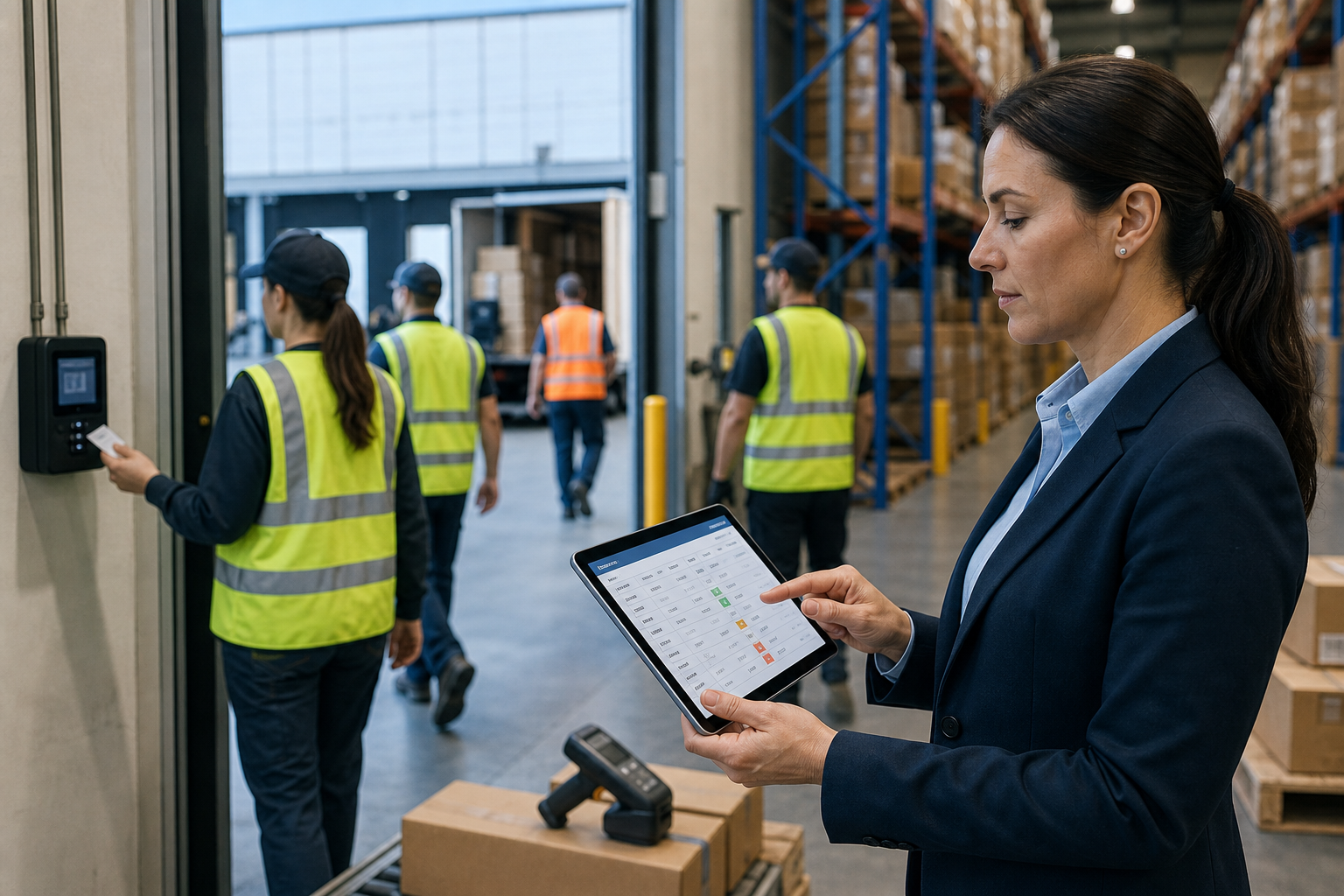
Warehouse labor is not controlled only by creating a schedule. The schedule is the plan, but the real operational control starts when employees arrive, clock in, pass required checks, work inside or outside the planned shift, and managers decide what should become payable time.
In many warehouses, these steps are disconnected. One tool stores the schedule. Another terminal records attendance. Supervisors approve exceptions somewhere else. Payroll receives a file at the end of the period and has to understand what happened. That creates mistakes, payroll leakage, disputes, and weak visibility over real labor cost.
Grownu helps warehouse and logistics teams connect warehouse workforce management, employee scheduling software, employee time tracking, time attendance terminals, logbook approvals, and payroll-ready records into one workflow.
Table of contents
- Warehouse scheduling is only the first step
- Match labor to demand and busy periods
- RFID, PIN, tablet, and mobile app clock-ins
- Breathalyzer checks for safety-sensitive warehouse teams
- Outside-schedule time should not automatically become paid time
- Logbook approvals, edits, and audit trail
- Collect work categories and performance data
- PTO and leave visibility before publishing schedules
- Payroll-ready warehouse timesheets
- Conclusion
- Frequently asked questions
Warehouse scheduling is only the first step
A warehouse schedule needs to cover more than names on a calendar. Managers often need to plan labor by shift, department, role, loading dock, receiving area, picking zone, packing line, forklift work, and shipping deadlines.
A good warehouse schedule should answer practical questions before the shift starts. Do we have enough people for picking? Is the packing team covered? Do we need extra people for inbound deliveries? Are trained employees available for equipment-heavy work? Who is on leave? Who is close to overtime?
With employee scheduling software, warehouse managers can plan coverage by shift, location, team, and role. But the schedule becomes much more powerful when it is connected to actual attendance and timesheets.
Match labor to demand and busy periods
Warehouse demand can change quickly. Order volume, seasonal peaks, inbound shipments, delayed trucks, returns, promotions, and same-day delivery expectations can all affect how many people are needed on the floor.
Demand-based planning helps managers compare expected workload with scheduled labor. Instead of using the same number of people every day, teams can plan around expected volume, department pressure, and busy periods.
For companies that want more advanced planning, AI shift scheduling based on demand can help connect labor planning with expected workload. This is especially useful when a warehouse has repeating patterns, known busy periods, or demand signals that can guide staffing levels.
RFID, PIN, tablet, and mobile app clock-ins
In warehouses, clock-in speed matters. Employees often arrive in groups at the same time, especially at shift changes. Paper timesheets and manual spreadsheets are too slow, too easy to manipulate, and too difficult to connect with payroll.
Grownu supports multiple time attendance terminals for warehouse environments. Employees can clock in with RFID, PIN, tablet kiosk, or mobile-based workflows depending on the setup.
A RFID time attendance terminal is useful when employees use cards, badges, fobs, or tokens. PIN can be used as a backup when a badge is missing. Supported devices can also include photo capture, helping managers verify who made the clock-in or clock-out event.
Some warehouses prefer tablet or smartphone-based terminals instead of dedicated hardware. In that case, a time attendance terminal with mobile app can turn a tablet or mobile device into a shared clock-in station using the Grownu app.
Breathalyzer checks for safety-sensitive warehouse teams
Warehouses, logistics sites, manufacturing floors, transport operations, and heavy-equipment environments often need stronger safety controls at shift start. For these workplaces, attendance control can include a breathalyzer workflow.
With a time clock terminal with breathalyzer, employees can identify with RFID or PIN, complete an alcohol test before clock-in or clock-out, and have the result recorded in Grownu. If the test fails or exceeds the configured limit, the work session can be restricted and responsible managers can receive a notification.
This workflow can also include photo capture during the test, failed-test logs, manager alerts, and history inside the system. For warehouses where safety, access, and shift accountability matter, this connects the attendance event with a clear record of what happened.
Outside-schedule time should not automatically become paid time
This is one of the most important warehouse payroll controls. Employees may arrive early, clock in before the scheduled shift, stay after the shift, forget to clock out, or remain near the terminal after work is finished. If every minute automatically becomes paid time, payroll costs can grow without manager approval.
When an employee clocks in before the scheduled start time or clocks out after the scheduled end time, Grownu can separate that time from the planned shift. The time outside the schedule is marked separately in the logbook and does not automatically move into the payable timesheet.
Managers can review each part of the entry and approve only the valid time that should become real working hours. For example, early time before the shift can remain unpaid if the employee arrived too early without approval. Late time after the shift can be approved only when the supervisor confirms that real work was performed.
This gives warehouses better control over payroll leakage without blocking legitimate overtime. The key is that outside-schedule time is visible, separated, and reviewed before it becomes payable.
Logbook approvals, edits, and audit trail
Warehouse attendance records often need manager review. There may be missed punches, manual corrections, early starts, late finishes, break issues, or employee explanations that need to be checked before payroll.
In Grownu, the logbook gives managers a place to review attendance events and exceptions before they affect the final timesheet. This includes outside-schedule time, manual entries, and edited records.
Logs of edits and manual actions are important. They help show what changed, who changed it, and why. For payroll and operations, this improves accountability and reduces the risk of silent changes to employee hours.
Collect work categories and performance data
Time tracking becomes more useful when the system also captures what kind of work was performed. After clock-in or clock-out, warehouses can collect additional categories such as department, activity type, job type, equipment used, order process, or work performed.
This can support better productivity analysis. Managers can compare hours against work categories, departments, or operational output. Over time, this helps calculate efficiency and performance metrics, not only attendance totals.
For example, a warehouse may want to understand how much time was spent on picking, packing, loading, receiving, returns, cleaning, equipment handling, or special projects. When this data is collected consistently, managers can make better staffing and process decisions.
PTO and leave visibility before publishing schedules
Scheduling breaks down quickly when approved leave is not visible. A warehouse manager may publish a schedule only to discover later that key employees are unavailable because of vacation, sick leave, or another approved absence.
Employee leave management helps managers see availability before publishing the schedule. This matters in warehouses because some roles require trained or certified people, and replacing them at the last minute can be difficult.
When leave, scheduling, and time tracking are connected, managers can plan coverage more accurately and reduce last-minute shift gaps.
Payroll-ready warehouse timesheets
The goal is not only to record time. The goal is to create clean, payroll-ready records that managers trust.
A connected warehouse workflow looks like this: schedule the shift, let the employee clock in through the right terminal, capture optional photo or safety checks, separate outside-schedule time, review exceptions in the logbook, approve valid hours, and send clean timesheets to payroll.
This helps warehouses avoid paying unapproved early or late time automatically, while still giving managers a clear way to approve legitimate overtime. It also gives operations better visibility into attendance, safety events, productivity categories, and labor cost.
Conclusion
Warehouse employee scheduling and time tracking should not be separate processes. The schedule is the plan. The terminal records what happened. The logbook explains exceptions. Manager approval decides what becomes paid time. Payroll receives the final result.
Grownu helps warehouse and logistics teams connect all of these steps in one system: schedules, demand-based planning, RFID and PIN clock-ins, mobile terminals, photo capture, breathalyzer checks, unpaid outside-schedule time, logbook approvals, edit history, work categories, PTO, and payroll-ready timesheets.