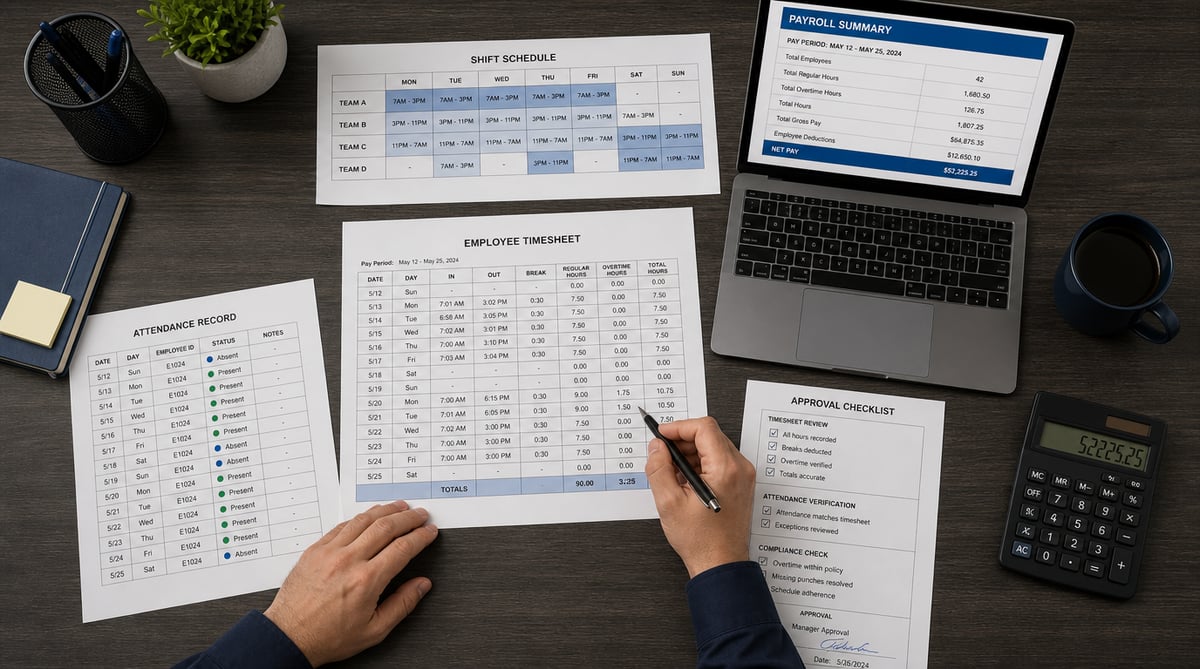
Payroll errors rarely begin inside payroll. They usually begin earlier: a missing clock-out, an unreviewed manual correction, overtime nobody noticed, leave that was not reconciled with the schedule, or time registered outside a planned shift.
If those issues are unresolved when payroll begins, the payroll team inherits operational questions it may not be able to answer. A proper approval workflow puts those questions in front of the manager before records are handed to payroll.
The objective is not to make managers process payroll. It is to make sure operations delivers a reviewed, approved, payroll-ready record.
Table of contents
- Why payroll approval should start before payroll day
- The payroll approval workflow from schedule to payroll-ready timesheet
- Manager timesheet approval checklist
- 1. Compare scheduled hours with worked hours
- 2. Resolve missed clock-ins and forgotten clock-outs
- 3. Review manual time corrections and audit history
- 4. Review time registered outside the scheduled shift
- 5. Check early clock-ins and late clock-outs
- 6. Review overtime before it becomes a payroll surprise
- 7. Check breaks and incomplete attendance records
- 8. Match leave and absence with the work schedule
- 9. Review project and task allocation where relevant
- 10. Separate correction from approval
- What payroll should receive — and what it should not
- How attendance terminals feed the approval workflow
- Payroll approval workflow by industry
- Do not wait until the end of the month to review time
- Use approval data to improve the next schedule
- How Grownu supports the pre-payroll approval workflow
- Final 10-point payroll approval checklist
- Conclusion
- Frequently asked questions
Why payroll approval should start before payroll day
Payroll errors rarely begin inside payroll. They usually begin earlier: a missing clock-out, an unreviewed manual correction, overtime that nobody noticed, leave that was not reconciled with the schedule, or time registered outside a planned shift.
When those issues remain unresolved, payroll inherits operational questions it did not witness. Payroll asks the manager, the manager asks the employee, and everybody tries to reconstruct a shift from days or weeks earlier.
A stronger workflow moves the review closer to operations. Managers resolve exceptions during the pay period and perform a final approval before payroll preparation. The principle is simple: payroll should receive reviewed records, not unresolved operational questions.
The payroll approval workflow from schedule to payroll-ready timesheet
A practical workflow connects planning, actual attendance, exceptions, corrections, approvals, and final payroll preparation.
- Schedule the work. Managers create shifts and expected working hours.
- Record actual attendance. Employees clock in and out through mobile or terminal workflows.
- Capture leave and absence. Approved leave is visible alongside planned and actual work.
- Identify exceptions. Missing punches, outside-schedule time, early clock-ins, late clock-outs, and unusual records remain visible.
- Correct factual errors. Authorized users resolve missing or incorrect records while preserving history.
- Review overtime and deviations. Managers establish why actual hours differ from the plan.
- Approve final time. The responsible manager confirms that the record is ready.
- Prepare payroll-ready timesheets. Payroll receives reviewed workforce records rather than raw attendance events.
Grownu connects employee scheduling, employee time tracking, and leave management around this operational flow.
Manager timesheet approval checklist
| Before approval | Manager checks | Final result |
|---|---|---|
| Scheduled vs worked | Unexpected differences | Verified hours |
| Missing punch | Actual start or finish | Corrected record |
| Outside-schedule time | Reason and operational context | Reviewed time |
| Overtime | Cause and required approval | Reviewed overtime |
| Leave | Approved absence and affected schedule | Correct absence record |
| Manual edit | Reason and change history | Auditable correction |
| Unapproved record | Completeness and context | Approved or returned record |
| Project/task time | Correct allocation where relevant | Reliable labor records |
The objective is not to create administrative work. It is to direct manager attention toward records that genuinely require judgment.
1. Compare scheduled hours with worked hours
The schedule is one of the strongest references during approval because it shows what the business intended to happen. But it remains a plan, not proof of attendance.
If an employee was scheduled from 08:00 to 16:00 and registered from 08:03 to 16:02, the difference may be straightforward. If the employee registered from 06:45 to 18:20, the manager has a stronger reason to investigate before approval.
The same applies when actual time is shorter than planned. The employee may have left early, taken approved leave, changed assignment, forgotten a registration, or have an incomplete record.
Connected scheduling and time tracking make differences visible without automatically replacing actual attendance with scheduled hours.
2. Resolve missed clock-ins and forgotten clock-outs
A payroll-ready timesheet should not contain unexplained missing starts or finishes.
When a punch is missing, the responsible manager should establish what happened, correct the record according to company procedure, and preserve the change history. The schedule can support the investigation, but it should not silently fill the missing attendance event.
This is covered in detail in our guide to correcting missed punches before payroll.
Resolving exceptions frequently is easier than waiting until the end of the pay period because managers and employees are more likely to remember the circumstances.
3. Review manual time corrections and audit history
Manual corrections are sometimes necessary. An employee can forget to register, a manager can verify an incorrect entry, or an operational event can require a legitimate adjustment.
The important question is not whether corrections exist. It is whether they are transparent.
Before approval, managers should understand the original record, the corrected value, who made the change, and why the final record differs from the initial attendance event.
An audit trail protects operational accountability and payroll preparation. It also helps identify patterns such as one location producing unusually high numbers of manual edits.
4. Review time registered outside the scheduled shift
Time outside the scheduled shift deserves special attention because it sits at the boundary between planning and actual work.
An employee scheduled from 09:00 to 17:00 may clock in at 08:42 or clock out at 17:28. Those are real registrations, but the manager still needs to understand why the difference occurred.
Grownu can preserve actual registrations and separate time outside scheduled hours for manager review before final payroll preparation.
Outside-schedule time should not automatically be treated as unpaid simply because it was not planned or authorized in advance. The manager should establish whether work occurred and apply the company's process. Applicable law, agreements, employment terms, and company policy determine how the time must ultimately be treated.An attendance system should preserve evidence and support decisions, not silently make legal conclusions about recorded working time.
5. Check early clock-ins and late clock-outs
Early arrivals and late departures can gradually increase labor cost even when individual differences look small.
If 30 employees regularly clock in ten minutes before their shifts, the cumulative difference can become significant. The correct response is not simply to erase registrations. Managers need visibility into the pattern and operational reason.
Some employees may arrive early for convenience without starting work. Others may be expected to prepare equipment, open a location, receive a handover, or perform real work before the scheduled start.
A clear employee attendance policy helps define expected behavior while manager review deals with actual exceptions.
6. Review overtime before it becomes a payroll surprise
Overtime should be visible during operations, not discovered for the first time when payroll totals are calculated.
Managers should review which employees exceeded expected hours, when the additional time occurred, why it occurred, and whether the pattern signals a scheduling or capacity problem.
Repeated overtime can indicate understaffing, uneven shift distribution, absence coverage problems, poor availability data, recurring late finishes, or demand that no longer matches the current schedule.
Our guide on reducing employee overtime without understaffing examines those causes in more detail.
A lack of prior overtime authorization should not automatically cause recorded working time to disappear. Actual records should be preserved and reviewed under the organization's rules and applicable requirements.
7. Check breaks and incomplete attendance records
Break-related exceptions can affect the final calculation of working time and should be resolved before approval where the organization's attendance workflow records them.
Managers should look for incomplete registrations, unexpected durations, or patterns that do not match the applicable work arrangement.
The system's role is to make the record visible. The organization's rules and applicable requirements determine how breaks are scheduled, recorded, paid, or excluded from working time.
8. Match leave and absence with the work schedule
Leave management belongs in the payroll approval workflow because an absence can otherwise look like missing attendance.
If an employee was scheduled to work but has approved leave, the manager should see that context while reviewing the period. If leave was approved after the schedule was created, planning and attendance should still reconcile correctly.
Connecting employee leave management with scheduling and time records reduces the need to compare separate calendars, emails, and spreadsheets.
Managers can distinguish approved absence from a missing punch, unexplained absence, or scheduling error before information reaches payroll.
9. Review project and task allocation where relevant
For project-based and field-service businesses, approved employee hours may have a second purpose beyond payroll: they can affect project cost, billable records, customer invoicing, and profitability analysis.
An employee may have worked the correct total number of hours but allocated them to the wrong project or task. Payroll hours could be correct while project reporting becomes inaccurate.
Grownu's project records and invoicing workflow connects working-time records with operational project information so businesses can review labor alongside expenses, billable records, and profitability where relevant.
This matters especially for construction, cleaning, maintenance, facility services, and other businesses where labor cost needs to be understood by customer, project, location, or task.
10. Separate correction from approval
A correction and an approval are not the same action.
A correction answers: What should this record contain? Approval answers: Has the responsible manager reviewed this record and is it ready to move forward?
An employee may report a missing punch. An authorized person may correct it. A manager may then approve the completed record.
In smaller businesses, the same manager may perform several steps. The important part is that the final status shows whether the record has completed the review process.
What payroll should receive — and what it should not
| Payroll should receive | Payroll should not have to investigate |
|---|---|
| Reviewed employee hours | Why an employee forgot to clock out |
| Approved corrections | Whether a manual edit is legitimate |
| Reviewed overtime | Why a shift unexpectedly ran late |
| Correct leave records | Whether a missing day was approved absence |
| Resolved attendance exceptions | Whether early or late registrations represent work |
| Payroll-ready timesheets | Raw operational disputes between plan and attendance |
This does not mean payroll has no validation responsibility. It means operational questions should be resolved by the people with the context to answer them before payroll processing begins.
Grownu supports this preparation layer. It produces payroll-ready records and timesheets rather than being described as automatically replacing the organization's payroll system.
How attendance terminals feed the approval workflow
For fixed workplaces, the quality of payroll preparation begins with convenient and reliable attendance capture.
Time attendance terminals give employees a shared point for recording work. Depending on the workplace, organizations can use RFID, PIN, compatible shared mobile/tablet devices, photo-supported workflows, or other supported methods.RFID attendance terminals are particularly useful where many employees begin or finish shifts around the same time. A mobile-app attendance terminal can provide a flexible shared attendance point.The terminal is only the first part. Registrations still need to connect to schedules, exceptions, corrections, and manager approvals so the final timesheet represents reviewed work rather than an unfiltered stream of punches.
Payroll approval workflow by industry
Manufacturing
Manufacturing businesses often have fixed shifts, shared attendance terminals, handovers, and overtime. Managers can review planned versus worked hours, missed registrations, late finishes, and corrections before approving the period.
Warehouses and logistics
Warehouses and logistics teams may have large shift groups and high attendance volume. Exception-based review focuses managers on missing punches, outside-schedule time, overtime, and manual changes.
Restaurants
Restaurants often have variable finishing times because closing, cleanup, demand, and staffing conditions do not always end exactly with the planned shift.
Retail
Retail businesses can standardize approval across stores while allowing responsible managers to resolve the attendance exceptions they understand locally.
Construction
Construction companies need reliable employee hours for payroll preparation and project labor analysis. Mobile attendance, project allocation, corrections, and approval can be reviewed together.
Cleaning
Cleaning companies may combine fixed-facility attendance with mobile crews moving between customers. Payroll approval needs to work across both models.
Facility services
Facility services often mix recurring planned work with reactive tasks. Reviewing actual time against schedules and assignments explains deviations before payroll and project reporting.
Healthcare
Healthcare and care organizations may have fixed facilities, shift workers, and mobile employees. Grownu supports workforce operations—scheduling, tasks, attendance, leave, approvals, and payroll-ready records—not clinical or patient record management.
Security services
Security services commonly operate nights, weekends, holidays, fixed posts, and handovers. Accurate start and finish records and timely exception review are particularly important.
Agriculture
Agricultural businesses can have seasonal demand, varying locations, and different attendance methods. A consistent approval process helps standardize the final payroll-ready record.
Field service and maintenance
Field service and maintenance businesses often need employee time connected to customers, tasks, locations, or projects. Managers can review total working time and operational allocation before finalizing the period.
Do not wait until the end of the month to review time
A payroll approval workflow works best when exception review happens throughout the pay period.
Daily review is useful for operationally intensive teams because managers can resolve a missing clock-out or unusual shift while everyone remembers what happened. Weekly review can identify accumulating overtime, repeated corrections, or scheduling patterns before they become expensive.
The final pre-payroll approval should therefore be a confirmation step, not the first time anyone looks closely at attendance data.
- Employees register work as it happens.
- Managers resolve obvious exceptions frequently.
- Weekly review catches developing patterns.
- Final pay-period review closes unresolved items.
- Approved timesheets are prepared for payroll.
Use approval data to improve the next schedule
The payroll approval process should not end with payroll. Differences discovered during review can improve future workforce planning.
If overtime repeatedly appears in the same department, the schedule may need more capacity. If one site generates frequent early clock-ins, the attendance policy or opening process may need review. If leave regularly creates last-minute coverage problems, managers may need better availability and absence visibility while planning.
Plan → work → register → review → approve → learn → plan better.That feedback loop is one reason workforce scheduling and attendance should not be treated as unrelated systems.
How Grownu supports the pre-payroll approval workflow
Grownu brings together the operational records managers need before payroll preparation.
- Employee scheduling and planned shifts
- Mobile time tracking
- Shared attendance terminals
- RFID and PIN attendance
- Leave and absence management
- Actual versus planned time
- Attendance exceptions
- Manual corrections and review
- Outside-schedule time
- Overtime visibility
- Tasks and project context
- Manager approvals
- Payroll-ready timesheets
- Project, expense, invoicing, and profitability records where relevant
The value comes from connecting the workflow. Managers do not need to reconstruct schedules from one system, attendance from another spreadsheet, leave from email, and corrections from payroll messages.
Instead, operations can review and approve the workforce record before handing it forward for payroll processing.
Final 10-point payroll approval checklist
- Are all required clock-ins and clock-outs present?
- Have scheduled-versus-worked differences been reviewed?
- Are manual corrections legitimate and traceable?
- Has time outside scheduled hours been reviewed?
- Are early clock-ins and late clock-outs understood?
- Has overtime been reviewed in its operational context?
- Are relevant breaks and attendance exceptions resolved?
- Is approved leave reflected correctly?
- Are project or task allocations correct where they matter?
- Are all required records approved and ready for payroll preparation?
If the answer to one of these questions is no, the record is not yet truly payroll-ready.
Conclusion
A reliable payroll approval workflow is not primarily a payroll function. It is the final operational quality check on the workforce records that payroll depends on.
Managers know why a shift ran late, whether an employee forgot to clock out, why a correction was necessary, whether leave explains a missing day, and whether additional recorded time reflects actual work. That context should be applied before payroll receives the timesheet.
The strongest workflow keeps planned schedules, actual attendance, leave, corrections, overtime, exceptions, and approvals connected. It preserves actual records instead of silently forcing them to match the schedule.
With Grownu, scheduling, time tracking, leave management, attendance terminals, project records, corrections, and approvals can contribute to one payroll-ready workforce record.